
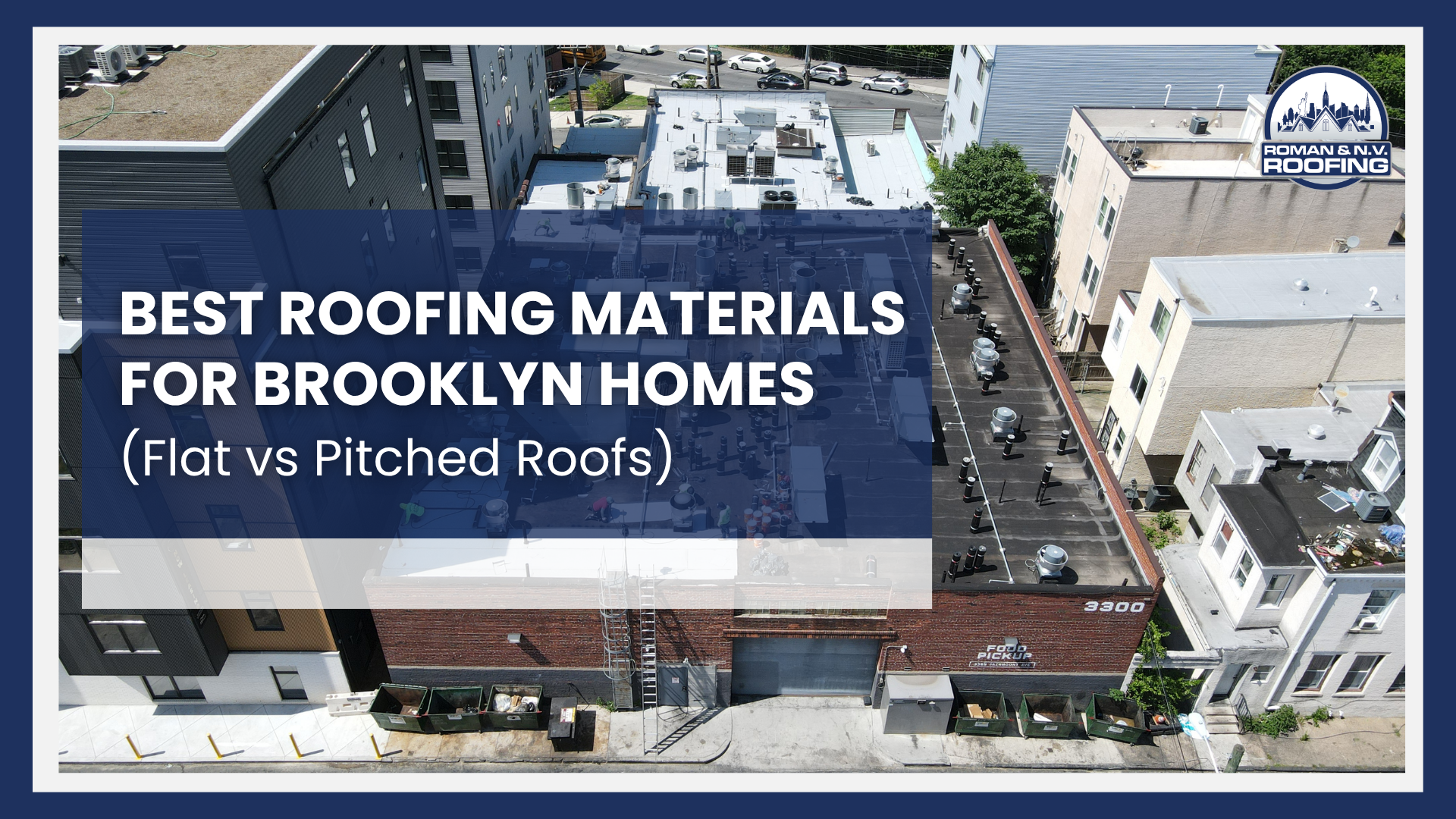
Brooklyn roofs take a beating that most of the country never sees. One season brings humid summers that cook membrane surfaces past 150 degrees. The next brings freeze-thaw cycles that crack, split, and pull apart anything that was not built to handle real stress. Most property owners only think about their roof when something goes wrong, and by then, the damage has already done its job.
That gap between "looks fine" and "actively failing" is where most Brooklyn roofing mistakes live. A material that works perfectly in mild climates can become a liability on a Brooklyn flat roof within five years. Pick the wrong product for a brownstone, and you are fighting moisture intrusion that travels through walls, ceilings, and floors before you ever see a visible leak.
The good news is that material selection is a solvable problem when you know what you are actually looking at. This blog breaks down the best roofing material Brooklyn properties need, flat and pitched, with the kind of detail that actually helps you make a smart call before work begins.
Flat Roofs Dominate Brooklyn For Good Reason
Walk through Bushwick, Bed-Stuy, or Crown Heights, and you will notice one thing fast. Flat roofs are everywhere, and that is not an accident. Brooklyn's rowhouse and commercial building stock was designed with flat roof systems because they maximize usable footprint, simplify drainage planning, and work well with the dense urban grid on which the borough was built.
But flat does not mean forgiving. A flat roof Brooklyn building carries standing water longer than any pitched system, which means membrane integrity is everything. Even a pinhole breach in the wrong spot can push water under the entire assembly before it shows up inside the building. The material you choose for a flat roof on a Brooklyn property is not just a surface decision. It is a waterproofing decision that affects the entire structure below it.
EPDM: The Workhorse of Brooklyn Flat Roofs
EPDM rubber membrane has earned its reputation on flat roof Brooklyn buildings the hard way, through decades of real-world performance in one of the harshest urban climates in the country. It handles temperature swings better than almost any competing product, expanding and contracting without cracking through dozens of freeze-thaw cycles per year.
A properly installed EPDM system on a flat roof in Brooklyn routinely delivers 25 to 30 years of service life. It is not glamorous. It does not come with a long list of feature claims. It just works, and in Brooklyn roofing, that consistency is worth more than any sales pitch.
TPO: The Energy-Smart Option
TPO membrane has become the best roofing material Brooklyn commercial property owners reach for when energy performance is part of the conversation. Its white reflective surface pushes back solar heat instead of absorbing it, which keeps rooftop temperatures significantly lower during New York summers and reduces the load on building cooling systems.
TPO also handles punctures and chemical exposure better than older membrane products, which matters on rooftops with HVAC equipment, exhaust vents, and regular foot traffic from maintenance crews. For flat roof Brooklyn buildings with active rooftop systems, TPO earns its place at the top of the material list.
Modified Bitumen: Old School With Real Results
Modified bitumen does not get the marketing attention that newer membrane products do, but it keeps showing up on Brooklyn flat roofs for a simple reason. It works on buildings that other materials struggle with.
Older Brooklyn structures often have roof decks with irregular surfaces, patched sections, and decades of previous installations underneath. Modified bitumen's layered torch-down application bonds directly to those surfaces and creates a fully adhered waterproof barrier that does not rely on perfect substrate conditions. Each additional layer adds another line of defense against water infiltration, and the bonded edge detail eliminates the wind uplift failures that plague mechanically fastened systems on exposed urban rooftops.
It is not the most energy-efficient option, and it carries a shorter expected lifespan than EPDM or TPO, but for complex flat roof Brooklyn jobs where surface conditions are unpredictable, modified bitumen remains one of the most dependable choices a contractor can recommend.
Pitched Roof Materials That Actually Hold Up
Brooklyn's pitched roofs are concentrated in neighborhoods like Bay Ridge, Dyker Heights, Flatbush, and Bensonhurst, where single-family homes and rowhouses make up most of the building stock. These roofs face wind-driven rain, ice dam formation at the eaves, and the physical stress of maintenance foot traffic across decades.
Asphalt and Architectural Shingles
Asphalt shingles remain the most widely installed product on pitched Brooklyn roofs, and the best roofing material Brooklyn homeowners can choose within that category is the architectural or dimensional shingle. These carry a more aggressive profile than standard three-tab shingles, shed water faster, and perform significantly better under high wind loads. Impact-resistant grades add another layer of protection against hail damage, which New York sees more often than most residents realize.
Slate: The Long Game
Slate is the other end of the spectrum. It costs more upfront than almost any other pitched roof material, but a properly installed slate roof delivers a service life that can exceed 100 years. For Brooklyn brownstone owners in it for the long term, no material comes close to matching that return on investment.
Standing Seam Metal Roofing
Standing seam metal roofing is gaining ground on Brooklyn pitched roofs for its fire resistance, snow-shedding ability, and low maintenance requirements over a very long service life. It carries a higher installation cost than asphalt but significantly lower lifetime maintenance costs, which makes the math work well for commercial and multi-family properties.
Brownstone Roofing Is Its Own Category
Brooklyn brownstones are not just old buildings. They are a specific construction type with specific roofing demands that generic material guides never address. Most were built between the 1860s and early 1900s using board sheathing with gaps between planks. Modern roofing systems assume a solid, continuous deck surface. Put the wrong membrane directly on a brownstone deck without proper underlayment, and you get bridging failures, punctures, and water paths that form within the first few seasons.
Understanding the Construction Underneath
Original brownstone roof decks require a solid underlayment layer before any surface material goes down. Parapet walls on flat brownstone sections create drainage challenges that demand specific membrane detailing and drain placement. Masonry walls in these buildings shift seasonally, and any membrane applied to adjacent flat sections must accommodate that movement without cracking at the transition points. This is where contractor experience matters more than material brand.
Working Within Landmark Requirements
In designated historic districts, the best roofing material Brooklyn brownstone owners can legally use is constrained by Landmarks Preservation Commission guidelines. Slate replacements must match the original profile and color. Copper flashing is required over aluminum in many situations because of its compatibility with old masonry and its significantly longer service life. Choosing materials without checking landmark requirements first is a costly mistake that forces full replacements before a single winter has passed.
NYC Code Compliance Is Not a Technicality
Here is something that catches Brooklyn property owners off guard more often than it should. Not every product marketed as the best roofing material Brooklyn suppliers sell actually meets New York City building code requirements for fire rating, wind uplift resistance, and energy performance under Local Law 97.
What Non-Compliance Actually Costs You
Code compliance is not paperwork for its own sake. Insurance carriers operating in New York are increasingly requiring documented proof of compliant installations before they will process storm damage claims. A non-compliant membrane on a flat roof of a Brooklyn building can result in a denied claim after a major weather event, regardless of how well the product performed under normal conditions.
The Right Way to Stay Protected
Pulling proper permits, using code-approved materials, and working with a licensed contractor who operates transparently are not optional steps on a Brooklyn roofing project. They are the foundation that every other decision sits on top of. Skip that foundation, and the best material on the market becomes a liability instead of an asset.
Conclusion
The difference between a roof that lasts 15 years and one that lasts 40 is rarely luck. It comes down to material knowledge, honest assessment, and installation that accounts for the specific building underneath. Brooklyn does not forgive shortcuts, and neither does a New York winter on a membrane that was never right for the job.
N.V. Roofing Services has built its entire reputation on getting this right. From flat roof Brooklyn commercial buildings to century-old brownstones with landmark designation, the team brings the kind of property-specific knowledge that turns a roofing project into a long-term investment. No generic packages, no hidden fees, no recommendations that do not serve the building first.
If you want the best roofing material Brooklyn buildings deserve installed by people who actually know this borough, reach out to N.V. Roofing Services today for a free, honest estimate.
Frequently Asked Questions (FAQs)
1. What is the best roofing material Brooklyn flat roofs perform best with?
EPDM and TPO membranes consistently outperform other options on flat roofs in Brooklyn buildings due to their climate adaptability and long service life.
2. How long does a flat roof last in Brooklyn?
A quality flat roof Brooklyn installation using EPDM or TPO membrane typically lasts between 20 and 30 years with proper maintenance.
3. Are architectural shingles better than standard shingles for Brooklyn homes?
Yes, architectural shingles shed water faster, handle wind loads better, and carry a longer expected lifespan than standard three-tab products.
4. Does the NYC building code limit which roofing materials can be used?
Every roofing material installed on a Brooklyn property must meet NYC fire rating, wind uplift, and energy code requirements to remain compliant.
5. Is slate roofing practical for Brooklyn brownstones?
For long-term ownership, slate delivers the strongest lifetime value of any pitched roof material available in the Brooklyn market.
6. Can a non-compliant roof installation affect my insurance coverage?
Yes, insurance carriers can deny storm damage claims on properties where non-compliant materials were installed without proper permits.
