
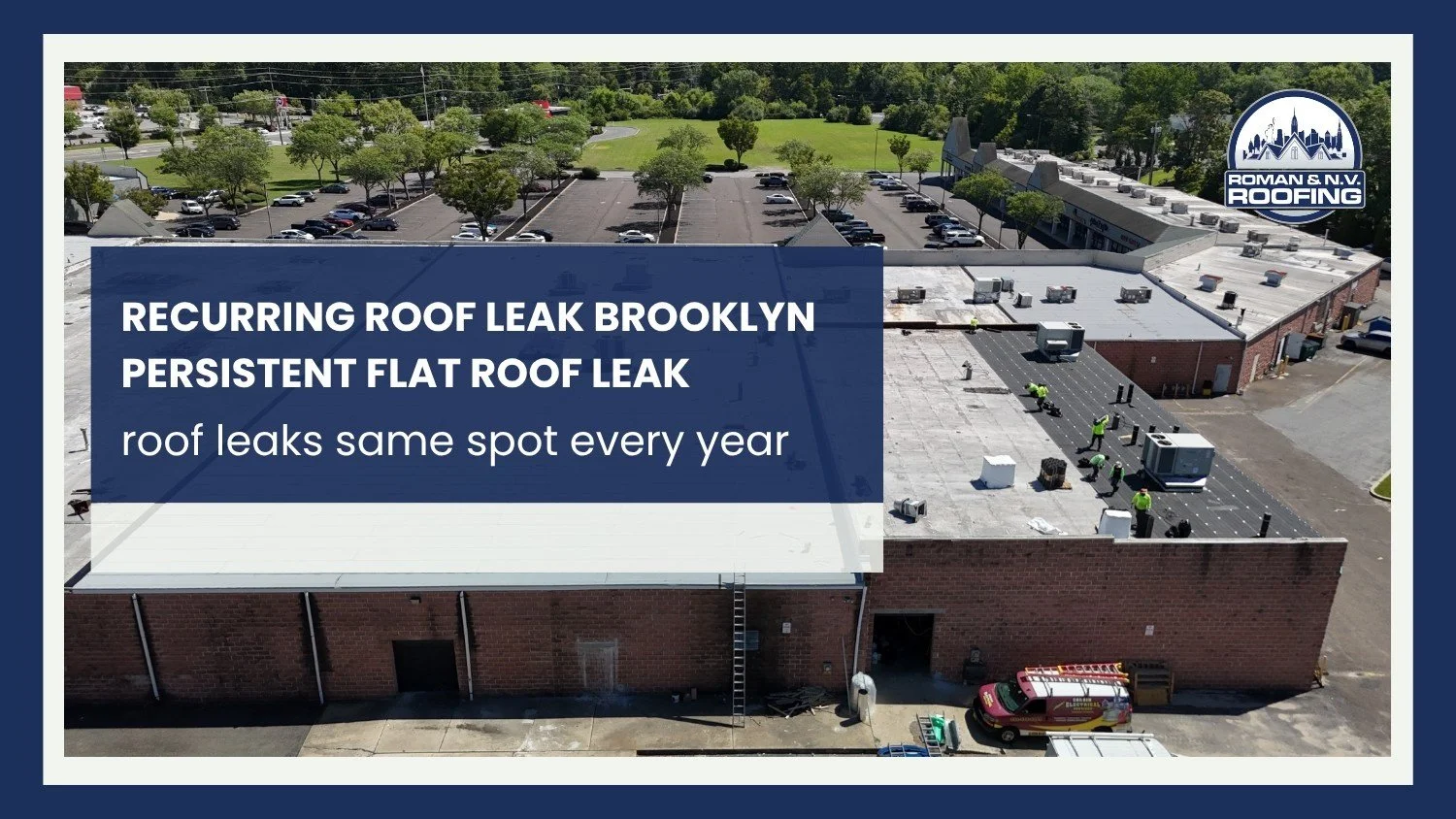
If the same ceiling tile stains every spring or the same corner drips every time it rains hard, the repair that was done before didn't fix the actual problem. A recurringroof leak in Brooklynalmost always means the water source was either misidentified, patched over without addressing the underlying failure, or left partially unresolved. The leak comes back because the cause never left.
This post breaks down why flat roofs develop repeat leaks at the same location and what a proper roof leak repair in Brooklyn actually needs to address to stop the cycle.
Why a Roof Leak Keeps Coming Back to the Same Spot
Water on a flat roof doesn't drop straight down through the ceiling. It enters through a breach in the membrane or flashing, then travels horizontally through insulation and roof deck materials before it finds a path downward. That means the spot where you see the leak inside the building is rarely directly below where water is getting in.
When a repair targets the visible drip point rather than the actual entry point, the underlying breach stays open. The next rain event pushes water through the same path, it accumulates in the same low point, and the same interior spot shows up wet again.
There are a few specific reasons this pattern repeats:
The breach was patched but not sealed at the source. Surface patching over a failed seam or cracked flashing can hold temporarily, but if the underlying material has deteriorated, the patch edges eventually lift and water re-enters.
Water was entering from multiple points. One was addressed, others weren't. The leak appears to return but is actually continuing from a secondary entry point feeding the same interior path.
The repair material wasn't compatible. Using the wrong sealant or patch product on a specific membrane type can result in adhesion failure within one to two seasons.
The real entry point is further away than expected. Water travels. A repair made three feet from the interior stain might be nowhere near where rain is actually getting in.
Understanding this is why effective roof leak repair in Brooklyn requires tracing the leak path, not just addressing what's visible.
The Most Common Sources of Persistent Flat Roof Leaks
Certain areas of a flat roof fail before others and are responsible for the majority of recurring leak situations in NYC apartment and commercial buildings.
Flashing failures at parapets and walls
Flashing is the metal or membrane material that seals the joint between the roof surface and any vertical element, whether that's a parapet wall, HVAC curb, chimney, or skylight frame. It's one of the highest-stress points on a flat roof because it sits at a transition where two different materials meet and move differently under temperature changes.
When flashing pulls away, cracks, or corrodes, it creates a gap that channels water directly into the roof assembly. Patching the membrane surface nearby doesn't address flashing that has separated from the wall above it.
Seam and lap failures
Flat roof membranes are installed in overlapping sections. Those seams are bonded with adhesive, heat welding, or tape depending on the membrane type. Over time, seams can separate, especially on older modified bitumen or EPDM systems where the adhesive bond has dried out.
A seam failure in one location can feed water into a long section of the roof cavity before it finds a way through the ceiling below. The interior drip point may be 10 to 15 feet from the open seam.
Blocked or slow-draining roof drains
Flat roofs depend on drains to move water off the surface quickly. When drains are partially blocked by debris, the water ponds longer and pushes harder against every seam, flashing edge, and penetration on the roof. A drain that's 60 percent blocked won't cause a visible backup, but it will extend ponding time enough to force water through marginal areas on every rain event.
Buildings that get a recurring roof leak in Brooklyn after every heavy rain but not light rain are often dealing with a drain restriction problem, not just a membrane problem.
Penetration seals around pipes and equipment
Every pipe, vent, and HVAC unit that passes through or sits on the roof creates a penetration point. The membrane has to wrap and seal around each one. Those seals are typically the first to fail because they're under constant stress from equipment vibration, thermal movement, and UV exposure at exposed edges.
A persistent flat roof leak that shows up near mechanical equipment or plumbing stacks is almost always a penetration seal failure that was either partially repaired or not addressed at all.
Why Surface Patching Fails on Recurring Leaks
Most temporary fixes involve applying a layer of sealant or a patch membrane over the area that looks damaged. In some cases, that's the right approach. In recurring leak situations, it usually isn't, and here's why.
Flat roof materials degrade from the top down. UV radiation breaks down the surface layer first, then works into the membrane body over time. When a membrane is aged enough to be leaking, the surrounding material is typically also compromised, even if it doesn't look bad yet. A patch bonded to degraded membrane won't hold long because the surrounding material it's bonded to keeps failing outward from the repair edge.
On top of that, most surface patching doesn't address what's happening at the seams or flashings adjacent to the patch. Water finds the next weakest point, which is usually a few feet away.
Roof leaks same spot every year is a pattern that almost always indicates the repair approach has been reactive rather than diagnostic. Each repair addressed what was visible at the time rather than what was allowing water in consistently.
What a Proper Recurring Leak Repair Involves
Fixing a persistent flat roof leak that keeps coming back requires a different approach than a standard spot repair. The process should work from the interior evidence outward to the actual water entry point.
Here's what that looks like in practice:
Map the interior damage to understand the extent of the affected area and the direction water has been traveling
Inspect the full roof section above, not just the area directly overhead, looking at all flashings, seams, drains, and penetrations within a reasonable radius
Use moisture detection where needed, whether infrared scanning or core cuts, to identify where the roof assembly is holding water
Identify the actual entry point, which may be significantly upslope or upwind from the interior stain
Address flashings, seams, and penetrations in the affected zone as a system, not individually
Replace saturated insulation if moisture scanning shows the assembly has been holding water, since wet insulation under a repaired membrane continues to cause problems
Verify the repair before closing out the job, ideally with a water test on the repaired section
This process takes longer than a patch job. It costs more upfront. But it's the difference between a repair that holds and one that gets repeated every season.
How to Tell If Your Roof Needs a Repair or a Replacement
Not every recurring leak situation means the whole roof needs to go. But some do, and it's worth knowing the difference before committing to another round of patch repairs.
A targeted repair makes sense when:
The leak is isolated to one area and the rest of the membrane is in reasonable condition
The affected flashings or seams can be replaced without disturbing the broader roof system
The roof deck is dry and structurally sound outside the leak zone
The membrane is mid-life, not at the end of its expected service span
A full replacement makes more sense when:
The same area has been repaired multiple times without lasting results
Moisture scanning shows widespread saturation across the roof assembly
The membrane is 20-plus years old and failing in multiple locations
The roof deck has rotted or delaminated sections that compromise the foundation for any repair
A qualified contractor should give you an honest read on which situation you're in before recommending a scope of work.
FAQ: Recurring Roof Leaks on Flat Roofs
Why does the same spot on the building roof leak every year? The same spot leaks every year because the actual water entry point was never correctly identified or fully repaired. On flat roofs, water travels horizontally through the roof assembly before dripping through the ceiling, so the visible interior leak point is often far from where rain is getting in. Repairs that target the drip location rather than the source allow the breach to stay open and produce the same leak path every rain season.
What causes a recurring roof leak in Brooklyn buildings? The most common causes are flashing failures at parapet walls or equipment curbs, seam separations in the membrane, blocked roof drains that extend ponding time, and degraded penetration seals around pipes and HVAC units. Any of these can be partially repaired without being fully resolved, which is why the leak returns. Brooklyn's freeze-thaw winters also reopen partially sealed gaps each spring.
Can a persistent flat roof leak be fixed without replacing the whole roof? Yes, in many cases. If the leak is isolated and the surrounding membrane and roof deck are in sound condition, a properly scoped repair that addresses the actual entry point can stop a recurring leak permanently. The key is identifying where water is entering, not just where it's showing up inside. If multiple areas are failing or the membrane is at end of life, replacement is the more durable solution.
How do I know if my roof leak repair in Brooklyn actually worked? A repair that holds through at least one full rain season, including heavy events, is a good indicator. Some contractors will water test the repaired section before closing out the job, which gives immediate confirmation. If the interior stain stays dry through the next several rain events, including storms, the entry point was correctly identified and sealed.
Why do roof leak repairs on flat roofs sometimes only last one season? Usually because the repair addressed surface symptoms rather than the underlying failure. Patching over a failed seam or applying sealant to aged flashing can hold through one dry season but fails again once freeze-thaw movement or summer heat expansion stresses the repair edge. Repairs that bond to already-degraded membrane material also lose adhesion faster than repairs made to sound substrate.
Getting the Leak Fixed Properly This Time
A roof that leaks in the same spot every year isn't unlucky. It's a sign that something specific in the roof assembly keeps allowing water in, and the repairs done so far haven't reached it.
The fix isn't necessarily expensive or disruptive. In many cases it's a matter of correctly tracing where water enters, addressing the flashings or seams that are actually failing, and using compatible materials applied to sound substrate. What it does require is a diagnostic approach rather than a reactive one.
If you're managing a Brooklyn building where the same leak keeps coming back every season,contact our team to get a proper assessment of what's actually causing it and what a lasting repair involves.
